
Green Sea turtles Saved, but the Struggle May Continue
Green sea turtles have been on the endangered species list since 1982, but in late 2025, they were moved to Least Concern. This change in classification was seen as a major conservation victory and suggested that decades of protection and environmental policies were beginning to work. However, this created the impression that green sea turtles were no longer at risk.
Green sea turtles faced many threats that caused their population to decline, including illegal hunting, accidental capture in fishing gear, coastal development that destroyed nesting beaches, and pollution in the ocean. One significant event that caused a decline in the green sea turtle population was the Deepwater Horizon Oil Spill in 2011, where it was estimated that over 6,000 sea turtles were killed due to the pollution from history's largest oil spill. Oil spills like this not only killed adult turtles but also contaminated nesting beaches and nearshore habitats, affecting hatchlings and food sources long after the spill itself was contained. Events like the Deepwater Horizon spill highlight how vulnerable marine species remain to human-caused environmental disasters.
The danger is not over for sea turtles, however, and there is another risk that could threaten their population sooner than we think. Unlike threats such as hunting or pollution, this risk is less visible and more difficult to control, making it especially dangerous. Climate change affects sea turtles before they even hatch, altering their biology rather than directly harming them. sea turtles lay their eggs and nest on the beach, the temperature of the sand determines the gender of the eggs, warmer sand produces all females (above 88 F ), cooler sand produces all males (below 81 F) and around 84 F can produce a mix. As global warming continues and more greenhouse gases get stuck in our atmosphere, trapping the heat of the sun and warming our earth, this also warms the sand. With temperatures rising across the world, this rise in sand temperature can threaten the population of green sea turtles and many other turtles, as females dominate the male population, leaving the females no way to reproduce. Though this will take many generations and decades.
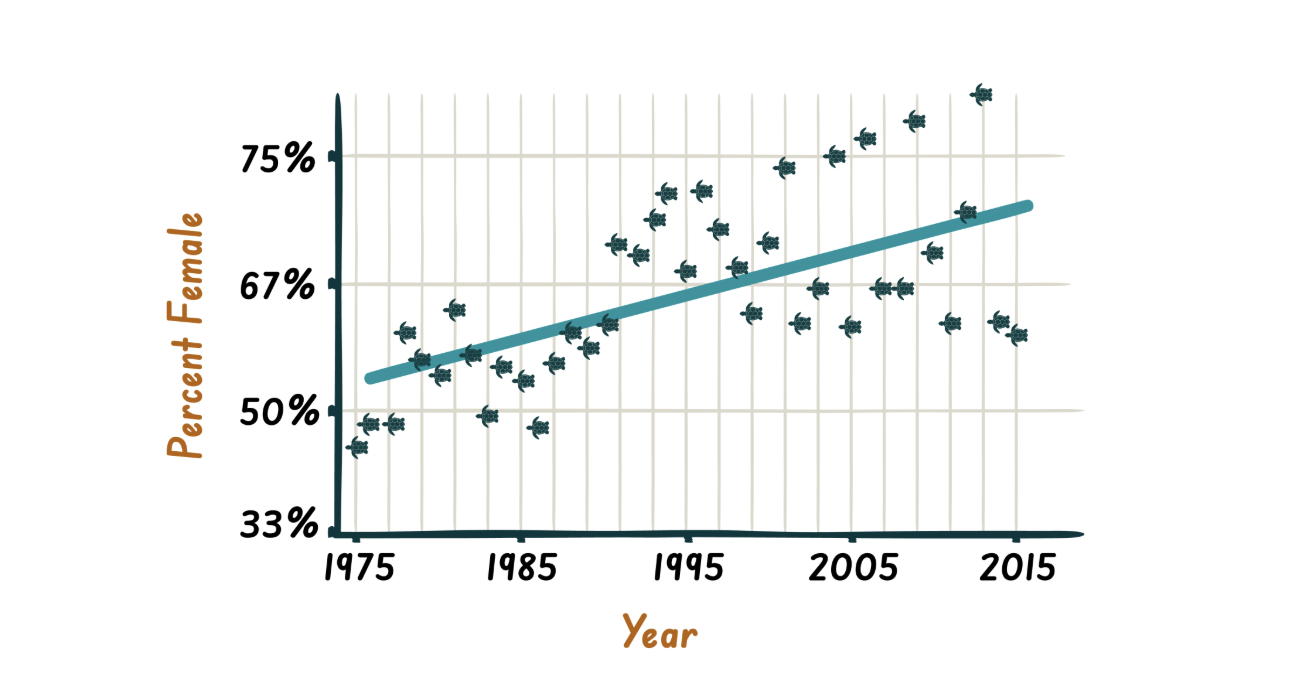
Image sourced from https://hakaimagazine.com/videos-visuals/in-graphic-detail-sea-turtle-feminization/
Showing rise of females sea turtles arriving in Bermuda.
With this change, some places have seen turtle populations move up their nesting season more and more to get cooler sand temperatures in order to balance the sex ratio. According to Oceanographic Magazine and a research study at the University of Exeter, they found that green sea turtles on a beach in North Cyprus were “laying eggs 6.47 days earlier for every 1°C increase in ocean temperature.”
However, there will come a day when the turtles can no longer move up their nesting any more when temperatures continue to rise as they have been. When temperature determines the sex of a species, the only thing we can do other than trying to mitigate climate change is to protect turtles in other ways, such as beach cleanups and properly protecting nests to ensure their survival for many decades to come. The recovery of green sea turtles shows that conservation efforts can be successful, but it also proves that protecting species must go hand in hand with addressing climate change itself.
Sources:
https://www.oceanicsociety.org/news-and-announcements/green-sea-turtle-status-improvement-2025/
